
Most people notice their first fine lines in an unflattering moment. The car’s rear-view mirror. A video call on a bad laptop camera. A friend’s photo taken in harsh afternoon light. And once you’ve seen them, the faint lines at the corners of your eyes, the soft creases around your mouth, you can’t really unsee them.
The good news is that fine lines are usually the easiest stage of skin ageing to work with. They sit closer to the surface, they haven’t settled into deep folds yet, and the skin around them still responds well when you give it a reason to rebuild. That’s exactly where HIFU face treatment comes in.
This guide covers what HIFU actually does to fine lines (and what it doesn’t), who it suits, what a session feels like, how long results take, and how it compares to the other options you’ve probably been reading about. No hype. Just what our doctors tell patients in consultation every week.
What Causes Fine Lines in the First Place?
Before talking about the fix, it helps to know what’s going on under the skin.
Your skin’s firmness comes mostly from two proteins: collagen, which gives structure, and elastin, which lets skin snap back after you smile or frown. From your mid-twenties, your body starts producing a little less collagen each year. It’s gradual, so you don’t notice it for a while. Then one day the lines you make when you laugh don’t fully disappear when you stop.
Several things speed this up, and in Dubai a few of them are hard to avoid:
- Sun exposure. UV rays break down collagen faster than almost anything else. Year-round sunshine is lovely for weekends at the beach, less lovely for your skin.
- Dehydration and air conditioning. Moving between 45°C heat outside and dry, cold air inside all day pulls moisture from the skin, which makes lines look sharper.
- Repeated facial expressions. Squinting, frowning, smiling. These create “dynamic” lines that slowly become permanent.
- Sleep, stress and smoking. All three affect how well your skin repairs itself overnight.
Fine lines vs wrinkles: why the difference matters
Fine lines are shallow, usually under 1 mm deep, and often only visible up close or when your face moves. Wrinkles are deeper and stay visible even when your face is relaxed. Then there’s laxity, which is skin that has started to loosen and drop, especially around the jawline and lower cheeks.
This matters because different treatments target different layers. Fine lines and early laxity often show up together, and HIFU happens to be good at working on both at once.
What Is HIFU Face Treatment?
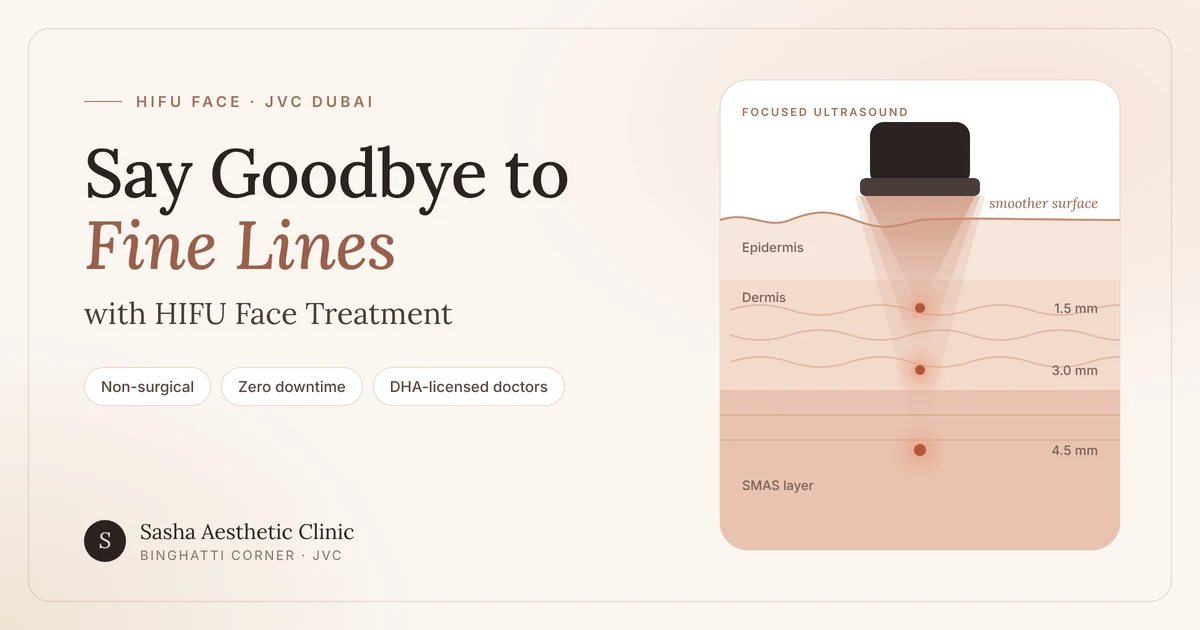
HIFU stands for High-Intensity Focused Ultrasound. Think of it like using a magnifying glass to focus sunlight onto a single point, except instead of light, the device focuses ultrasound energy onto precise depths beneath your skin.
At each focal point, the tissue warms to roughly 60–70°C for a fraction of a second. That creates tiny, controlled zones of heat while the skin surface stays untouched. Your body sees those zones as something to repair, and it responds by producing fresh collagen and tightening existing fibres. Doctors call this process neocollagenesis.
A 2017 study in the Journal of Cosmetic Dermatology explains that because the energy is focused several millimetres down, the tissue above and below the focal point is left unaffected. That’s why there’s no wound, no peeling and no real downtime.
Why the SMAS layer matters
HIFU can reach the SMAS (superficial musculoaponeurotic system), which is the same deep supporting layer a surgeon tightens during a facelift. Most non-surgical treatments simply can’t get that deep. By treating the SMAS alongside the more superficial dermis, HIFU tightens the foundation and the surface at the same time.
For fine lines specifically, the shallower cartridges (usually 1.5 mm and 3.0 mm) do most of the work. The deeper 4.5 mm cartridge handles lifting. A good practitioner uses a mix depending on what your face needs, which is why the consultation is not just a formality.
Does HIFU Really Work on Fine Lines?
Short answer: yes, with realistic expectations.
HIFU is best known as a lifting and tightening treatment. Fine-line improvement is a very welcome side effect of the collagen it stimulates, rather than its headline job. On our own HIFU face page we list fine lines as suitable, but we’re upfront that they’re not the primary target.
The research supports this. In a study published in the Annals of Dermatology, 20 patients treated across seven facial areas all showed improvement in wrinkles and laxity at three and six months, with the strongest results along the jawline, cheeks and around the mouth. A separate review of micro-focused ultrasound for the mid and lower face describes the same mechanism of collagen and elastin remodelling.
Where HIFU helps fine lines most
- Around the eyes (crow’s feet): modest softening, plus a subtle lift at the outer brow that makes the eye area look more open.
- Around the mouth (perioral lines): often one of the better-responding areas.
- Lower face and jawline: tightening here reduces the creasing that comes with early sagging.
- Neck: horizontal “necklace” lines and crepey texture can improve noticeably.
Where something else may work better
If your lines only appear when you move, for example frown lines between the brows or forehead lines when you raise your eyebrows, those are caused by muscle activity. Anti-wrinkle injections relax those muscles and usually give a faster, more targeted result. Lots of patients combine the two: Botox for expression lines, HIFU for overall firmness.
Who Is a Good Candidate?
HIFU tends to suit you if:
- You’re roughly 30 to 60 and starting to see fine lines, softening along the jaw or mild drooping in the cheeks.
- You want visible improvement but aren’t ready for, or don’t want, surgery or injectables.
- You can’t take time off. You want to go back to work the same afternoon.
- You have any skin tone. Because HIFU uses ultrasound rather than light, it’s safe across all skin types, which matters a lot in a city as diverse as Dubai.
When we’d suggest waiting or a different route
- Pregnancy or breastfeeding
- Active acne, infection, open wounds or a rosacea flare in the treatment area
- Metal implants, plates or rods in the treatment path
- Autoimmune or connective-tissue conditions (these need a proper clinical assessment first)
- Severe laxity, where a surgical opinion may honestly serve you better
We’d always rather tell you HIFU isn’t right for you than sell you a session that won’t deliver.
What Happens During a HIFU Session?
Before your appointment
- Stop retinoids, AHAs and BHAs for about three days beforehand.
- Come in with a clean face, no makeup.
- Tell your doctor about any recent fillers, peels or laser treatments in the area.
On the day
- Assessment. Your doctor looks at your skin thickness, the depth of your lines and how much laxity there is, then picks the cartridges and energy settings.
- Cleansing. Every trace of makeup and oil comes off.
- Gel. A layer of ultrasound gel lets the energy pass through properly.
- Treatment. The handpiece moves across your face in lines. You’ll feel warmth, tingling or a light prickling. Bony areas like the jawline and forehead can feel a little sharper, and settings can be adjusted if needed.
- Finish. Soothing serum and SPF go on, and you’re done.
A session usually takes 45 to 90 minutes per area. There are no bandages, no needles and no recovery room.
Does it hurt?
Most people describe it as uncomfortable rather than painful. A warm, pin-prick sensation that comes and goes in pulses. It’s over quickly in each spot, and the overall experience is far easier than most people expect.
Results Timeline: When Will Fine Lines Start to Fade?
This is the bit people find surprising. HIFU doesn’t give you an instant “wow” in the mirror. It starts a process.
Timeframe | What you’ll likely notice |
|---|---|
Same day | Mild redness for an hour or two. Skin may feel slightly tight. |
1–2 weeks | An early sense of firmness. Some tenderness along the jaw is normal. |
4–8 weeks | Fine lines start to look softer as new collagen forms. |
2–3 months | The main result. Smoother texture, firmer skin, better definition. |
6–12 months | Results hold. A maintenance session keeps them going. |
Because the change comes from your own collagen, it looks natural. Friends tend to say you look rested, not that you’ve “had something done.”
How many sessions will you need?
One session is often enough to see a difference. For fine lines combined with early laxity, many patients choose a course of three sessions spaced about a month apart for a fuller, longer-lasting result. After that, a top-up every 6 to 12 months is typical.
Aftercare: Protecting Your Results
Aftercare is simple, but it genuinely affects how good your results look:
- Wear SPF 50 every day. Freshly stimulated skin is more sensitive to the sun, and UV damage undoes the collagen you’ve just built.
- Skip saunas, steam rooms and hot yoga for 48 hours.
- Avoid vigorous facial massage for about five days.
- Makeup is fine the same day if you want it.
- Hydrate and moisturise. Well-hydrated skin shows results better, especially in air-conditioned offices.
HIFU vs Other Treatments for Fine Lines
You’ve probably come across several options. Here’s a fair comparison:
Treatment | Best for | Downtime | Results last |
|---|---|---|---|
HIFU face | Fine lines plus early laxity, jawline, neck | None | 6–12 months |
Expression lines (forehead, frown, crow’s feet) | None | 3–4 months | |
Texture, pores, acne scars, surface lines | 1–3 days of redness | Builds with a course | |
Volume loss, deeper folds | Minor swelling | 6–18 months | |
Hydration, glow, maintenance | None | Short term, best done regularly |
Combining treatments for better results
Fine lines rarely have a single cause, so a combined plan often works best. A few pairings our doctors regularly recommend:
- HIFU + Botox: HIFU firms the skin overall, Botox handles the movement lines. Usually spaced a couple of weeks apart.
- HIFU + PDRN (salmon DNA): HIFU tightens the deeper layers while PDRN supports skin quality and repair from the surface.
- HIFU + regular HydraFacials: keeps skin hydrated and glowing between HIFU sessions.
Your doctor will suggest the right order and timing at your free consultation.
Is HIFU Safe?
When it’s done by a trained medical professional on a proper device, HIFU has a strong safety record. The technology has been used in aesthetics for well over a decade, and the original micro-focused ultrasound system received US FDA clearance for a non-invasive brow lift back in 2009.
Common side effects are mild and short-lived: redness, slight swelling, tenderness or tingling for a few days. Rarer effects like small bruises or temporary numbness usually settle on their own.
The biggest safety factor is who’s holding the handpiece. HIFU delivers real energy into real tissue, and the wrong depth or energy level over the wrong area can cause problems. In the UAE, look for a clinic licensed by the Dubai Health Authority (DHA), and ask directly whether a doctor will perform or supervise your treatment.
Why Choose Sasha Aesthetic Clinic for HIFU in Dubai?
At Sasha Aesthetic Clinic in Jumeirah Village Circle, every HIFU treatment is performed or directly supervised by a DHA-licensed doctor. We’re part of the Sasha Group, a Dubai beauty name since 1994, and you can meet our medical team before you book.
- Honest consultations. If HIFU isn’t the right fit, we’ll tell you plainly.
- Protocols for every skin tone. Settings are calibrated for the wide range of skin types we see in Dubai.
- Flexible plans. Single sessions, a course of three, or a premium face, neck and under-chin protocol.
- Easy payments. Split costs with Tabby or Tamara on selected treatments.
- Convenient location. Shop 11, Binghatti Corner, JVC, with free parking, about 10–15 minutes from Dubai Marina, JLT, Sports City and Al Barsha.
Frequently Asked Questions
HIFU softens fine lines rather than erasing them. Most people see a clear, natural improvement in texture and firmness, which makes lines much less noticeable. For movement lines, adding Botox often gives the smoothest overall result.
Typically 6 to 12 months, depending on your age, skin condition, sun habits and lifestyle. A maintenance session once or twice a year keeps results going.
They do different jobs. Botox relaxes the muscles that cause expression lines. HIFU builds collagen and tightens skin. If your lines are mostly from movement, Botox is usually quicker. If they come with some loosening or crepey texture, HIFU is the better fit. Many patients use both.
Most patients start in their early to mid-thirties when fine lines and mild laxity first appear. Starting early can help slow visible ageing, but there's no fixed age. It depends on your skin.
Yes. There's no downtime. You may have some redness for an hour or two, and you can wear makeup the same day.